 Sacred Guardian
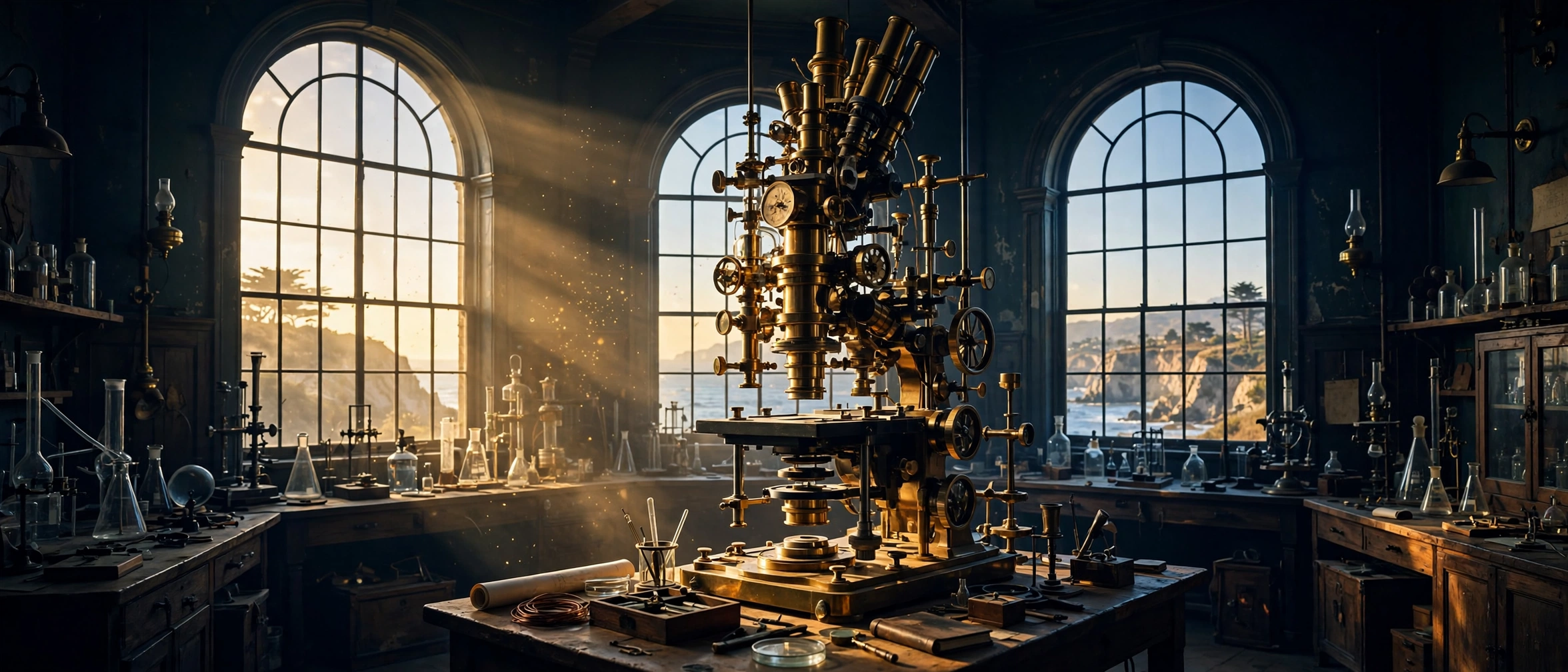
Point Loma, San Diego, in the early 1930s. The laboratory has gone dark except for one instrument, and a man is sitting at it the way he has sat for most of the night — he would sometimes work twenty hours at a stretch to bring a single virus into focus. Through lenses of solid quartz, in light bent and split by prisms, he is watching living organisms no microscope on earth was supposed to be able to show him: viruses, alive, moving, each glowing in a color of its own. The one he has hunted through more than twenty thousand cultures over seven years — the organism he believes stands behind cancer — glows purplish-red.
His name was Royal Raymond Rife. In his lifetime, prominent physicians dined in his honor and a university committee supervised his clinical work. By the end of it, his company was bankrupt, his laboratory in pieces, his closest collaborator dead, and he died, by his own account, a pauper. This is his story — told the way he and the people around him recorded it, in their own documents, letters, and testimony.
The man, and the men who believed in him
Rife was born on May 16, 1888, in Elkhorn, Nebraska. His mother died when he was eight months old, and he was raised by an aunt. He grew into an instrument builder of rare patience. Rife biographies describe studies at Johns Hopkins and research in Germany; his gift, the record makes certain, was building things no one else could build.
He settled in San Diego in 1912, and in 1913 he met the man who changed his life: Henry Timken, founder of the Timken Roller Bearing Company. Rife began as Timken’s chauffeur. Then Timken set him a factory problem — hairline fractures hidden inside chrome-steel bearings — and Rife designed an X-ray inspection machine that found them, reportedly saving the company millions. Timken rewarded him with a monthly payment for life, and the patronage only deepened: Rife traced Mrs. Timken’s baffling illness to bacteria in her spice cabinet, and when Timken’s sister Amelia Bridges died in 1940, she left him $50,000 to continue his work.
Timken and his partner funded a fully equipped laboratory at Point Loma and paid a staff of twelve assistants — no university politics, no commercial deadline, no one to answer to but the work itself. The literature is consistent that this independence made everything that followed possible. His associate Ben Cullen remembered him as “one of the most gentle, genteel, self-effacing, moral men I ever met.”
A microscope that stained with light
Ordinary microscopes kill what they examine. Chemical stains poison the specimen, and the electron microscopes then emerging destroyed it outright — a virus could be seen only dead, never watched alive. Rife’s answer, built over twenty years and five microscopes, was the instrument he completed in 1933: the Universal Microscope.
The fullest contemporary description of it was published by R. E. Seidel and M. Elizabeth Winter in the Smithsonian Institution’s Annual Report for 1944. By their account it contained 5,682 parts, was built entirely of block-crystal quartz, and reached a magnification of 60,000 diameters, at a time when ordinary research microscopes reached roughly 2,500.
But the power was not the revolution. The revolution was the light. Instead of staining specimens with chemicals, Rife stained them with light itself. Two counter-rotating prisms — the Risley prism system — swept a narrow band of the spectrum up through the living specimen, and when the band came into exact accord with the organism, the organism answered: it emitted its own characteristic color, and you saw it lit in its true chemical color, alive. The color key, as the Smithsonian report records it: the cancer organism, purplish-red; typhoid, turquoise-blue; tuberculosis, emerald green; B. coli, mahogany; leprosy, ruby red.
He was not alone at the eyepiece. In November 1931, Arthur Kendall, Director of Medical Research at Northwestern University, brought his protein K Medium to San Diego, and the two men watched typhoid bacilli pass into a filterable form — small, oval, actively moving, turquoise-blue — invisible to ordinary instruments. The following summer, Edward Rosenow of the Mayo Foundation re-checked the work and confirmed what they had seen.
What Rife saw changed his understanding of disease itself. The organisms changed. A microbe was not one fixed form, as the orthodoxy of his day insisted, but could pass into other forms as its environment changed — in as little as 48 hours, with a shift in its medium of as little as four parts per million. “In reality,” he wrote, “it is not the bacteria themselves that produce the disease, but the chemical constituents of these micro-organisms enacting upon the unbalanced cell metabolism of the human body.” A body in balance, he held, is susceptible to no disease. The enemy was never just the germ. It was the terrain.
The rate that shatters
The microscope and the machine were always one system. Rife would place a living culture under the Universal Microscope and sweep a frequency instrument across its range, watching. At most frequencies, nothing. Then, at one precise rate, the organisms in the field of view would burst — devitalized by structural stress, shattered at the frequency peculiarly their own, while everything around them, resonating at different rates, stood unharmed.
He called that lethal rate the Mortal Oscillatory Rate — in his later sworn testimony, “coordinative resonance.” His laboratory standard was uncompromising: an organism was not counted destroyed until he had destroyed it ten consecutive times at its rate. By his records he found the rate for at least twenty-four microorganisms. The cancer organism he named BX had its rate, found the same way: by watching.
His own summary, written in 1953:
“With the frequency instrument treatment, no tissue is destroyed, no pain is felt, no noise is audible, and no sensation is noticed. A tube lights up and 3 minutes later the treatment is completed. The virus or bacteria is destroyed and the body then recovers itself naturally from the toxic effect of the virus or bacteria. Several diseases may be treated simultaneously.”
The dinner, and the summer of 1934
On November 20, 1931, Dr. Milbank Johnson — Pasadena physician and former USC professor — hosted a dinner at his home honoring Rife and Kendall. More than thirty prominent doctors, pathologists, and bacteriologists attended. In the literature, that evening is remembered by the name the guests themselves are said to have given it: “The End of All Disease.”
Three years later came the test. In the summer of 1934, on the Scripps estate in La Jolla, sixteen terminally ill patients were brought from Pasadena County Hospital and treated under a Special Medical Research Committee of the University of Southern California, chaired by Johnson and including clinician George Dock and pathologist Alvin Foord. The protocol was the laboratory’s own: three minutes at the Mortal Oscillatory Rate for BX, every third day — daily treatment had proven too much, and the spacing let the body clear the devitalized organisms a layer at a time. Before any human being was treated, Rife states, the work had been done more than four hundred times with experimental animals.
The outcome survives in Rife’s own report, written December 1, 1953:
“16 cases were treated at the clinic for many types of malignancy. After 3 months, 14 of these so called hopeless cases were signed off as clinically cured by the staff of five medical doctors and Dr. Alvin G. Foord, M.D., pathologist for the group. The treatments consisted of 3 minutes duration using the frequency instrument which was set on the mortal oscillatory rate for 'BX' or cancer (at 3 day intervals).”
Barry Lynes, whose 1987 book The Cancer Cure That Worked reconstructed this history from the surviving documents, adds that the remaining two patients recovered after about one more month. No patient-level file from that summer survives — Rife lent his clinic documentation to a colleague, and it was lost — so the record of 1934 is Rife’s report and the literature that preserved it, presented here as exactly that. Rife himself never overstated it in public. In May 1938, with newspapers announcing that disease germs had been destroyed by rays, he told them: “We do not wish at this time to claim that we have 'cured' cancer.”
The doctors who kept going
The work did not end in 1934. The Beam Ray Corporation built fourteen frequency instruments, engineered by Philip Hoyland, the radio engineer who had found how to produce Rife’s high frequencies as sidebands on a carrier wave.
James Couche of San Diego had two instruments built for him and used the frequency generator until his death in 1959 — more than two decades. Rife’s sworn answers recall Couche’s own brother, whose thirty-year sinus condition, with terrible drainage, cleared in three weeks. R. T. Hamer came to the work as a patient first — his own severe sinus infection relieved through Couche’s machine — then took an instrument to the Paradise Valley Sanitarium, opened his own clinic, and was later forced out of it. In England, B. Winter Gonin worked with equipment sent across the Atlantic. And the applications widened beyond cancer: Johnson wrote of some thirty-two cataract cases corrected in 1936 alone, in an eye clinic he ran in Pasadena.
The turn
What follows is the story as Rife’s own circle told it, and as Lynes documented it in 1987 — the Rife side of the record.
In Lynes' account, Morris Fishbein, the powerful editor of the Journal of the American Medical Association, sent an attorney to buy into the Beam Ray technology. Rife refused. The terms of that approach survive in no document — what the literature records is the refusal, and what came after.
In 1939, Philip Hoyland — the engineer who had built the clinical machines — sued the Beam Ray Corporation. Beam Ray won the lawsuit. The legal bills bankrupted it anyway, and production stopped for good. Ben Cullen remembered Rife shaking uncontrollably in that courtroom, and a doctor advising him to take a drink to calm his nerves; the literature dates Rife’s alcoholism from that trial. In March of that year, the Burnett Laboratory in New Jersey — whose scientists, the literature reports, were preparing to announce confirmation of Rife’s work — burned down, in a fire the Rife literature describes as arson. Doctors who used the machines were threatened with their licenses; men who had stood beside Rife began to deny they had ever met him. Between 1944 and 1946, a technician stole a quartz prism from the Universal Microscope, and the great instrument went dark.
And in October 1944, Milbank Johnson died. After his death, the committee’s records disappeared, and the committee disbanded. No official cause of his death survives in the record; Lynes records that suspicion of poisoning followed it — two federal inspectors who examined his hospital record years later, Lynes writes, concluded he had likely been poisoned. That suspicion is part of the literature, not a finding, and we leave it where Lynes left it. What is not suspicion is the silence that followed: the chairman dead, the records gone, the doctors scattered.
The second silencing
Rife rebuilt a working life in the 1950s beside engineer John Crane, reconstructing from memory the rates and schematics lost in 1939. By 1960, some ninety of their instruments had been built. That year, Crane’s laboratory was raided and the machines and records seized. Rife, nearly seventy-three, withdrew to Mexico, where in March 1961 he answered 137 questions under oath — a deposition not permitted at Crane’s trial. There, by Lynes' account, fourteen patients testified the instrument had helped them where other medicine had not, while the state’s medical witness acknowledged he had been given a machine for two months and had never turned it on. Crane was convicted, sentenced to ten years, and served three years and a month; the California Supreme Court later reversed two of the three counts.
Rife’s own words from those years are the closest thing he left to an epitaph: “Having spent every dime I earned in my research for the benefit of mankind, I have ended up a pauper, but I achieved the impossible and would do it again.” He died in El Cajon, California, in August 1971, aged eighty-three. The San Diego Union's obituary remembered him, in full, as “an optics engineer who invented a high-power microscope.”
What survived
Not everything was lost. The fifth of Rife’s microscopes sits today in the Science Museum in London, engraved with his name and the year 1938. His laboratory notes, ledgers, letters, and frequency charts are gathered in the archive at rife.org. In 1987, Lynes published The Cancer Cure That Worked, and the story found its readers again. In the 1990s, New Mexico chiropractor and electronics experimenter James Bare read that book and rebuilt a plasma-tube device on Rife’s principles; more than a thousand builders followed his plans. The machines running today descend from that revival — plasma-tube instruments closest to Rife’s and Hoyland’s design, contact instruments from Crane’s lineage — and their frequency libraries carry rates that trace back to a man watching colors through quartz prisms in a dark laboratory.
That is why the modern Rife machine exists at all. We have written about how it works in What Is the Spooky2 Rife Machine — and How Does It Work? — the machine has changed across ninety years, but the idea at its center has not: find the frequency a harmful thing resonates at, meet it at that frequency, and let the body do what it was made to do. It is the idea Rife spent his life on, and lost nearly everything for. We think it deserved better than silence.
If what you’ve read here resonates with you — if you could use this kind of quiet, steady support flowing to you day and night — that is exactly what Sacred Guardian Frequencies was created to offer. We keep the machines running around the clock, so the frequencies are there for you wherever you are, and whatever you are facing. Take a look at the tracks we run, and if one of them feels like it was made for you, it would be our honor to run it for you.
Wherever you are, you’re covered.
Sources & Further Reading
- Barry Lynes, The Cancer Cure That Worked: Fifty Years of Suppression (Marcus Books, 1987)
- R. E. Seidel and M. Elizabeth Winter, “The New Microscopes,” Journal of the Franklin Institute, February 1944 — reprinted in the Smithsonian Institution Annual Report for 1944
- The Royal Rife document archive — laboratory notes, ledgers, letters, and frequency charts — https://rife.org
- Science Museum, London — record of the Rife Prismatic Compound Microscope No. 5 (1938), inventory 1990-667 — https://www.sciencemuseum.org.uk
- San Diego Union and San Diego Evening Tribune coverage of Rife’s work, 1929–1938