 Sacred Guardian
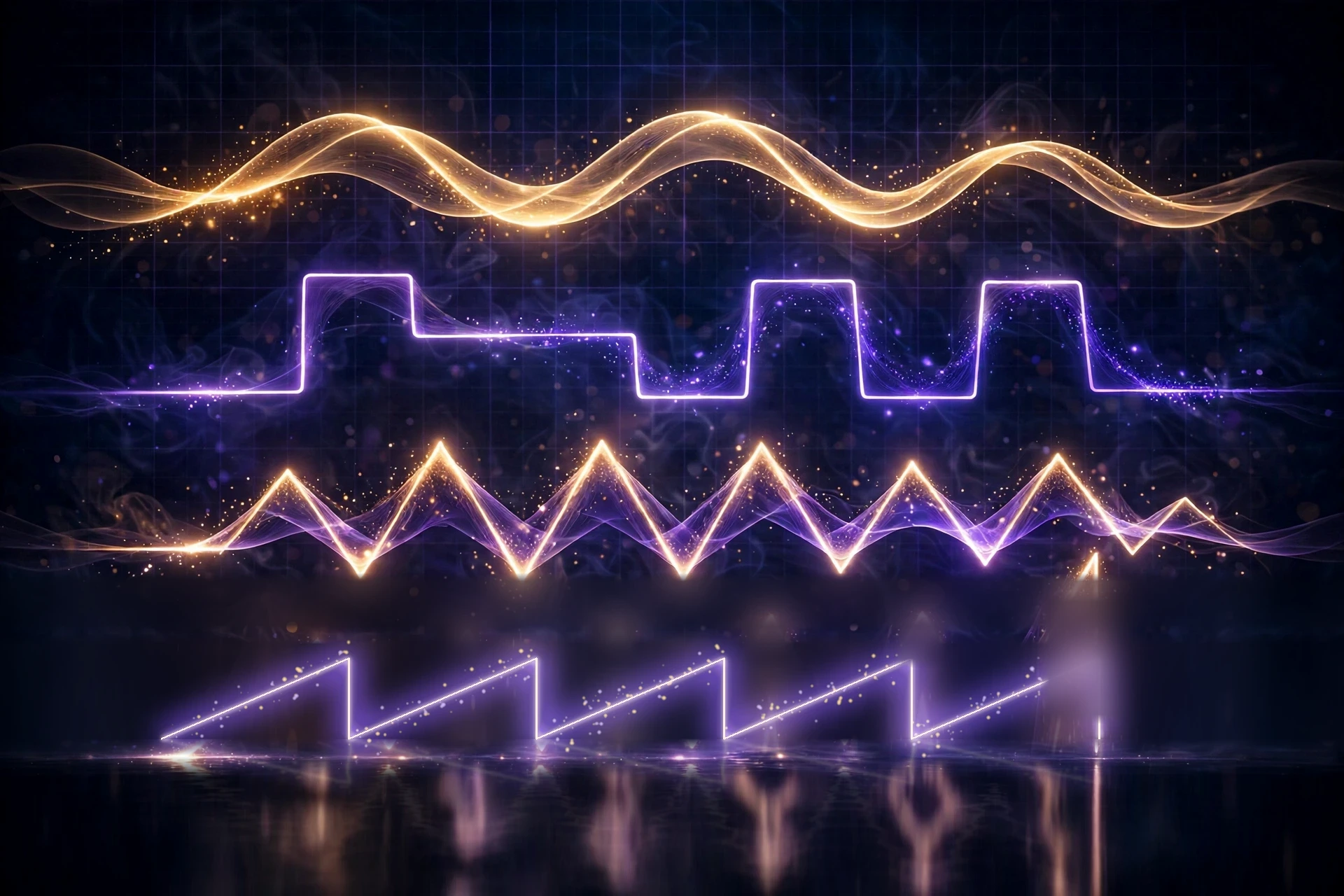
A frequency is only a number until two further decisions give it character. The first is the waveform: the shape the energy takes as it rises and falls, cycle after cycle. The second is the dwell: how long each frequency is transmitted before the program moves on to the next one. Every Spooky2 user meets both settings within the first hour, usually without anyone explaining them. This article explains them properly — what a waveform is, why one shape does most of the work, what dwell time is, and how the two trade against each other every time a program runs.
The shape of a frequency
A waveform is the pattern of a signal’s rise and fall. One complete trip through the pattern — up, down, and back to the start — is a cycle, and the frequency is simply how many of those cycles pass each second. Two signals can carry the identical frequency and still be different instruments, because the shape of the cycle differs. A bell and a drum can sound the same note; nobody mistakes one for the other.
Shape matters because of where a wave’s energy is spent. A wave delivers its force at the moments it changes direction — at its peaks and troughs. The comparison used in the Spooky2 guides is a whip: along the smooth run of the whip almost nothing happens, and all the power arrives at the crack, where the direction reverses. A wave that changes direction gently spreads its energy gently. A wave that reverses sharply concentrates it. That single fact explains most of what follows.
The main shapes
Spooky2 generates nine waveforms in all. Five unaltered shapes cover nearly everything a user will ever select, and each has a settled character.
The sine wave is the gentle curve — a smooth rise, a smooth fall, nothing abrupt anywhere in it. It is the purest form of the motion, the shape found throughout the natural world, and its gentleness makes it the natural healing wave. At high frequencies it kills efficiently as well, but its home ground is restoration.
The square wave is the opposite temperament. It rises to full power almost instantly, holds its peak, drops just as suddenly, and holds its trough. Those abrupt reversals are why it is normally the killing wave: the energy arrives as a series of sharp blows rather than a smooth push. It is also genuinely effective for healing, especially at low frequencies — a versatility no other shape matches.
The triangle wave climbs and descends in straight, even slopes. It has no history in Rife’s own work, and its linear slopes produce a weaker whip-crack than the square wave’s sharp reversals. Its honest use is as a possible, more linear substitute for a sine wave, where a gentler, straighter delivery is wanted.
The sawtooth wave rises smoothly through its cycle and then drops all at once. It, too, has no history in Rife’s work; Spooky2’s own experiments have found it a very effective healing waveform. Its mirror image, the inverse sawtooth, rises almost instantly and falls away in a straight line — and that combination makes it one of the strongest killers, more effective against organisms than the square wave. The sharpness that makes it a superior killer is also why it is kept away from delicate work at high power: a wave built to break things is the wrong instrument for a frequency resonating with an organ.
Why the square wave is the workhorse
The square wave’s second gift is invisible in its shape, and it is the deeper reason the square wave carries so much of Spooky2’s work: harmonics.
A harmonic is a companion frequency produced alongside the one transmitted, at an exact multiple of it — twice the frequency, three times, five times, and so on. A perfect square wave is built from odd harmonics: the 3rd, the 5th, the 7th, the 9th, continuing upward. This means a single square-wave transmission is never one frequency acting alone. It is the named frequency plus a whole family of its multiples, delivered together, each one able to resonate wherever it is answered. One setting reaches targets the operator never typed in.
That is why the square wave does both kinds of work well. Delivered for killing, its harmonics widen the strike. Delivered for healing — particularly at low frequencies — it entrains effectively. John White’s foundational JW-Healing preset family is built on the square wave for exactly this reason, and it is the beginner’s default because the shape forgives either direction. The inverse sawtooth goes further for killing work by adding the even harmonics to the odd, which is part of why it outperforms the square wave against pathogens — and part of why it is reserved for that work.
The lesson is plain: the waveform is not a decoration on the frequency. It decides how much of the spectrum a single frequency actually covers, and how hard the energy lands when it arrives.
Dwell: how long each frequency stays
Dwell is measured in seconds, and it answers one question: how long does this frequency run before the program steps to the next one? The standard dwell in Spooky2 program data is 180 seconds — three minutes on each frequency before the program moves on. Programs carry their own dwells as part of their data, and a setting called the Dwell Multiplier scales them all at once: a multiplier of 2 stretches every dwell to six minutes, and a multiplier of .5 shortens them to ninety seconds.
Dwell matters because resonance is not instantaneous in its effects. A frequency needs time on station — time for the energy to be received where it resonates, and for the work at that frequency to be done — before moving on serves any purpose. A dwell cut too short turns a program into a roll call: every frequency named, none of them given time to work. The three-minute standard holds that balance: long enough for a frequency to do its work, and short enough for a program of many frequencies to finish in a reasonable sitting.
The trade every program makes
Dwell cannot be considered alone, because it multiplies. A program’s total running time is its number of frequencies, times the dwell, times however many repeats are set. A forty-frequency program at the standard three-minute dwell takes two hours for a single pass. Double the dwell and the same program takes four.
So every program is a bargain between depth and coverage. Long dwells give a small set of frequencies deep, sustained attention — the right shape for focused work on a known target. Short dwells spread a fixed amount of time across many frequencies — the right shape for broad work, where covering the field matters more than lingering on any one point in it. Neither is better in itself. The error is choosing one while believing the benefits of the other come with it: a long program at long dwells may simply never finish, and an unfinished program delivers only its first frequencies, in order, every time.
This is also why presets deserve respect as they are written. A preset is a program whose waveform, dwell, and companion settings have already been chosen together, by the person who built it, for the work it is meant to do. Changing the dwell on a considered preset is sometimes right — but it is a decision about the depth-versus-coverage bargain, and it should be made as one, not as a casual adjustment.
One neighbouring setting is worth distinguishing before closing, because it is often confused with both of the above. Amplitude is the signal’s strength — its voltage. Waveform is the shape, dwell is the stay, and amplitude is how hard the whole thing is driven. The three are independent, and a program’s character comes from all of them together.
The shape and the stay, together
Frequency work looks, from the outside, like a list of numbers. In practice it is numbers given a shape and given time. The shape decides how the energy lands and how far its harmonics reach; the stay decides how long each frequency is allowed to do its work before the next one takes its place. Understand those two, and the rest of the Spooky2 settings begin to explain themselves.
Sacred Guardian Frequencies runs the restorative side of this craft: a remote Rife machine frequency service delivering support, healing, regeneration, and protection frequencies from our generator array, around the clock. In our own tracks, the shape and the stay are part of the work itself. The waveform runs as the preset was written to run, and every frequency is given the full measure of its dwell — because a frequency’s work is done by its shape and its time together, and to slight either one is to change what arrives.
Wherever you are, you’re covered.