 Sacred Guardian
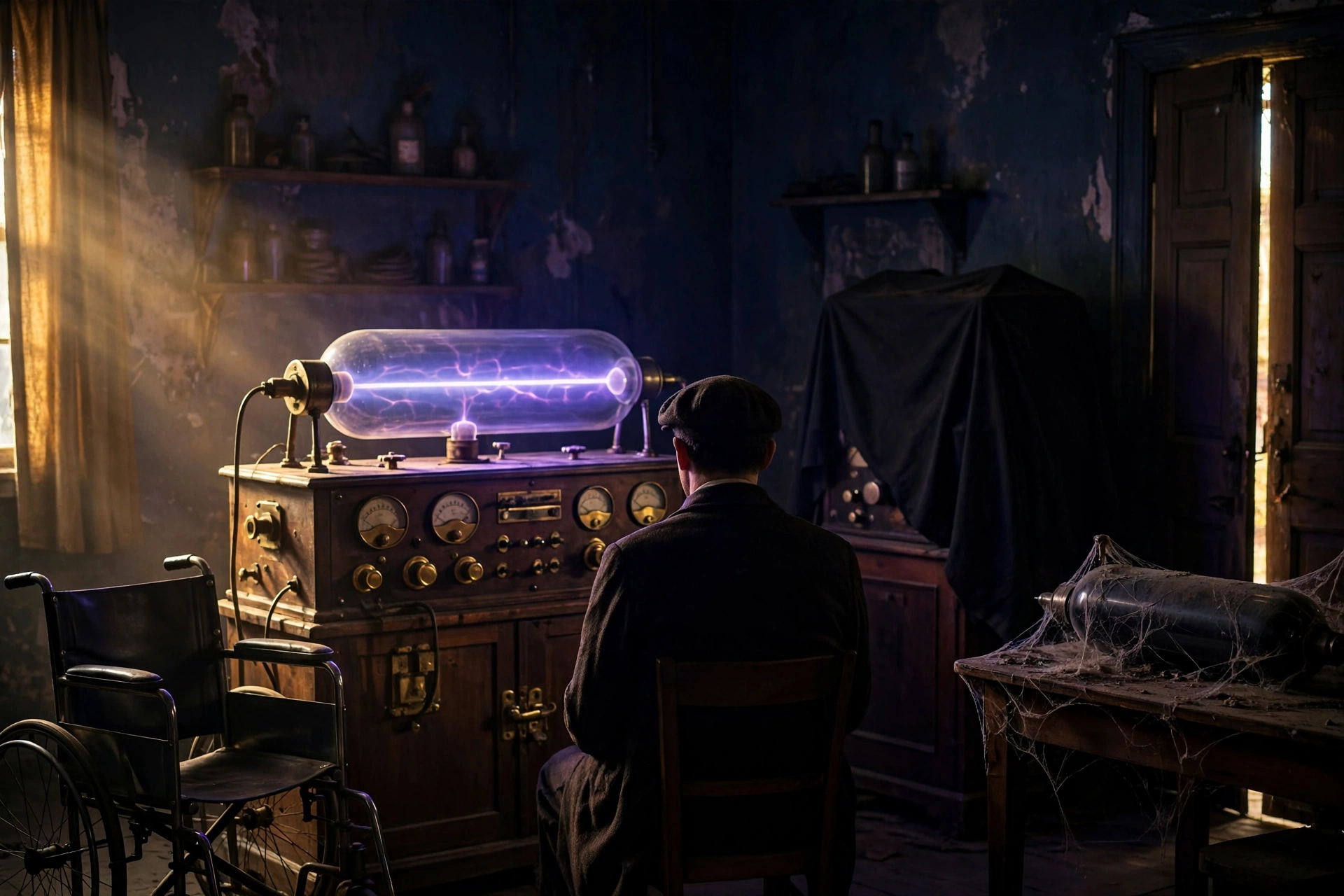
The Story of Royal Rife tells the man: the microscope, the Mortal Oscillatory Rate, and the summer of 1934. This post tells what happened to the work itself — the people it reached, the company, the lawsuit, the pressure, the raid, and the fifty years at the margins that ended in a revival. The record is uneven, and this post keeps it sorted: some of it stands in court files and contemporary documents, and much of the middle survives through Barry Lynes' 1987 history, reconstructed from the papers of the men involved. Documented fact is stated as fact; the literature’s account is named as such.
Rife gave the work his adult life. He had seen what the frequencies did for people who had been given up on, and he did not stop.
The clinic of 1934
In the summer of 1934, sixteen terminally ill patients were brought from Pasadena County Hospital to the Scripps estate in La Jolla. The work was supervised by the Special Medical Research Committee of the University of Southern California, chaired by Dr. Milbank Johnson, with five medical doctors and Dr. Alvin G. Foord, pathologist for the group. The treatment was three minutes at the Mortal Oscillatory Rate for BX, repeated every third day.
What became of the sixteen rests on Rife’s own report of December 1, 1953, carried here as exactly that. After three months, Rife reported, fourteen of these “so called hopeless cases were signed off as clinically cured by the staff of five medical doctors and Dr. Alvin G. Foord.” Lynes adds that the remaining two recovered after about one more month. That the surviving account was written in 1953, nearly twenty years after the clinic, is itself part of the story: the clinic’s own records did not survive to tell it, and the outcome comes down to us through the report Rife set down when the work was being taken up again.
Their names did not survive. Rife later lent his cancer-clinic documentation to Dr. Arthur Yale, and it was lost; no patient-level file from that summer exists in any archive.
A company to carry the work
After 1934, the work needed instruments other hands could build. The Beam Ray Corporation, formed in San Diego in 1937–38, built fourteen frequency instruments in the commonly cited production figure. Follow-on clinics ran through 1935–37. At a Pasadena eye clinic, Johnson reported — in a letter preserved in John Marsh’s history — that he and another doctor had corrected some thirty-two cataract cases in 1936. Physicians used Beam Ray machines for years afterward — Dr. James Couche of San Diego used his until his death in 1959.
What the machines did in one practice survives in Rife’s sworn answers of 1961. Recalling Couche’s practice, Rife named cases he had personally seen: cancer and tuberculosis cases “that had completely recovered”; Couche’s brother, over from England, whose thirty-year sinus condition, with terrible drainage, cleared in three weeks; Dr. Hamer’s sinus condition, cleared; and Dr. Butterfield’s brother-in-law, whose stiff wrist — tuberculosis of the bone — was cleared. Hamer had come to the work as a patient: his own severe sinus infection was relieved through Couche’s machine. Couche gave him an instrument for the Paradise Valley Sanitarium, and Hamer opened his own clinic in National City. He was later forced out of it.
The machines carried a compromise inside them. Philip Hoyland, the radio engineer who engineered the clinical instruments, reached Rife’s high frequencies indirectly: a fixed carrier wave of about 3.3 MHz, modulated by audio frequencies, so the true rates arrived as sidebands. The design hid the working frequency from competitors — and from everyone else. Different machines shipped with different carrier and modulation sets, so researchers who shared their settings were unknowingly working with different frequencies. Results conflicted, and the conflict was blamed on the method rather than the machines. The Hoyland instruments produced useful results, but they never replicated the original clinic’s — a judgment stated in Spooky2’s own Spooky Central User’s Guide and supported by the technical record.
The offer, and the pressure
The Rife literature’s central claim about organized medicine comes through Lynes, and it is carried here as exactly that. In Lynes' account, Morris Fishbein — editor of the Journal of the American Medical Association and the AMA’s dominant executive — sent an attorney to buy into the Beam Ray technology. Rife refused. No document of that approach survives: the terms are unknown, and later retellings that attach figures to it rest on secondary sourcing. The refusal is what the literature records.
What the literature documents next is a pattern rather than a single act. California physicians who used the machines were threatened with the loss of their licences. Doctors who had defended Rife lost foundation grants and hospital privileges. By 1939, men who had stood beside him were denying they had ever met him. Couche, who did not give up, recalled that the whole participating group was blackballed from medical organizations.
1939: the fire and the lawsuit
In March 1939, the Burnett Laboratory in Alpine, New Jersey, burned down. Its scientists, the literature reports, were preparing to announce confirmation of Rife’s work. The Rife literature describes the fire as arson. No independent investigation record confirming arson has been located; the fire is presented here as the literature reports it — a destruction, at the worst possible moment, whose cause the record does not settle.
The lawsuit is documented. In 1939 Hoyland sued the Beam Ray Corporation, seeking sole ownership of the technology. The trial opened on June 12, 1939, before Judge Edward Kelly. Beam Ray won the case. The legal bills bankrupted the company anyway, and production stopped for good. The trial carries one irony: its transcript survives, and researchers now use Hoyland’s sworn testimony as a technical source for how the machines were built — the lawsuit preserved part of the history it ended.
The losses of the 1940s
What followed was a staged disappearance. Between 1939 and 1946, components, stop-motion photographs, film, and written records vanished from the San Diego laboratory in pieces. Between 1944 and 1946, a technician stole a quartz prism from the Universal Microscope, and the great instrument was rendered inoperable.
In October 1944, Milbank Johnson died — the committee’s chairman and the work’s most credible medical sponsor. After his death, the committee’s records disappeared and the committee disbanded. No official cause of his death survives in the record. Lynes records a suspicion of poisoning, and is careful with it: the evidence, he writes, is circumstantial, though two federal inspectors who examined Johnson’s hospital record years later concluded poisoning was likely. That suspicion is part of the literature, not a finding. Even the year was later misremembered: Rife, answering under oath in 1961, gave Johnson’s death as 1942.
The rebuild: Rife and Crane
The work resurfaced in the 1950s, in a smaller room. Rife rebuilt a working life beside engineer John Crane, with John Marsh, through Allied Industries and then Life Labs. Because the losses of 1939 had taken the documentation, Rife reconstructed the rates and schematics from memory; a circuit diagram of Hoyland’s instrument reached Crane from Dr. Gruner in Canada. Crane’s line took the technology in a new direction — contact instruments, and the frequency lists divided down into the audio range. Most of the “Rife frequencies” circulating today descend through that Crane-era layer, which is one reason the same condition can carry very different numbers in different sources.
A compilation Crane and Marsh assembled — “Results With Rife Frequency Instruments After M.D. Diagnosis and Medicines Failed To Help People” — preserves what the instruments did for individual patients in those years. It records Barbara Sensenbaugh’s account of her varicose veins: the soreness gone after three treatments, the swelling largely gone after eight, and no operation needed. The same compilation records her baby’s staphylococcal skin infection, cleared “right away,” and another witness whose bleeding hemorrhoids and prostate trouble, dating to 1947, were “completely cured.”
By 1960, some ninety Crane–Rife instruments had been built and distributed under research contracts, and Crane had copyrighted a manual on the instrument’s use.
1960–1961: the raid and the trial
In 1960, Crane’s laboratory was raided. Machines, engineering data, research records, tape recordings, and parts were seized; the rest was smashed. In Lynes' account, the raid was carried out without a search warrant. The dollar figures the literature gives for the seizure conflict with each other, so none is stated here.
Rife, nearly seventy-three, withdrew to Mexico. From Tijuana, in March 1961, he answered 137 questions under oath — the fullest statement of his theory and his history that he ever gave. The deposition was not permitted at Crane’s trial. Neither was the documentary evidence gathered for the patients' side: Dr. Robert P. Stafford of Dayton, Ohio, had tabulated fifty-two cases treated after M.D. diagnosis — fifteen of them malignancies — in a January 1961 letter compiled for the trial, and per Lynes, Stafford’s reports and Couche’s letters were ruled inadmissible.
The trial ran twenty-four days in the spring of 1961: The People of the State of California v. John Marsh, Lallas Bateson, and John Crane, on charges of practising medicine without a licence and selling illegal medical devices. Fourteen patients testified that the instrument had helped them where other medicine had not. Lynes' account names one of them: James Hannibal, seventy-six years old and blind in one eye, whose cataract disappeared after several applications and whose chronic bladder irritation was cured. Together the fourteen testified to a throat lump half the size of an egg, eliminated; arthritis; an ulcerated colon; varicose veins; prostate trouble; back pain; and a growth the size of an egg on one man’s spine, present for seventeen years, that had disappeared. The state’s medical witness, in Lynes' account, acknowledged he had been given a frequency instrument for two months and had never turned it on. Crane was convicted and sentenced to ten years; he served three years and a month. The California Supreme Court later reversed two of the three counts, holding that no specific criminal intent had been proven.
Rife’s own verdict on those years survives in his 1960 affidavit, preserved in the literature: “The AMA has suppressed all effort and research knowledge of my developments.”
The last decade
Rife lived out the 1960s in California, with the work in pieces around him — microscopes scattered, much of the frequency catalogue lost. He died in El Cajon, California, in August 1971, aged eighty-three. By then the work had no company, no clinic, and no institution. What it had was paper, and a few people who kept it.
What survived
The paper survived. Rife’s laboratory notes, ledgers, letters, and frequency charts are gathered today in the archive at rife.org. One instrument survived intact: the fifth of his microscopes sits in the Science Museum in London, engraved with his name and the year 1938.
In 1987, Barry Lynes published The Cancer Cure That Worked, reconstructing the story from the surviving documents — with John Crane, Rife’s collaborator, as his principal source, the channel through which most of this history reaches us. In the mid-1990s, James Bare, a New Mexico chiropractor and electronics experimenter, read the book and rebuilt a plasma-tube device on Rife’s principles; his book of plans put the build into the hands of more than a thousand experimenters.
The machines running today descend from that revival by lineage. Plasma-tube instruments stand closest to Rife’s and Hoyland’s design. Contact instruments descend from Crane’s work. Function-generator systems carry the frequency libraries — the rates themselves, passed down through the Crane-era lists and the community compilations built on them. We have written about the modern machine in What Is the Spooky2 Rife Machine — and How Does It Work?. The work survived because individuals kept the papers, rebuilt the machines, and passed the lists hand to hand. Everything in use today — every plasma tube lit, every frequency list passed on — exists because one man saw what this could do for suffering people and refused to let it die. The people helped since are people he never saw. The help reached them because he held on. It deserved a better fate than silence, and in the end it did not get silence.
Sources & Further Reading
- Barry Lynes, The Cancer Cure That Worked: Fifty Years of Suppression (Marcus Books, 1987)
- The 1939 Beam Ray trial transcript
- An Interview with Royal Raymond Rife — the 137 questions and answers, March 1961 (Peter Walker’s transcription)
- Crane & Marsh, “Results With Rife Frequency Instruments After M.D. Diagnosis and Medicines Failed To Help People,” and Dr. Robert P. Stafford’s case tabulation (January 1961) — preserved at rife.org
- The Royal Rife document archive — laboratory notes, ledgers, letters, and frequency charts — https://rife.org
- Science Museum, London — record of the Rife Prismatic Compound Microscope No. 5 (1938), inventory 1990-667 — https://www.sciencemuseum.org.uk